
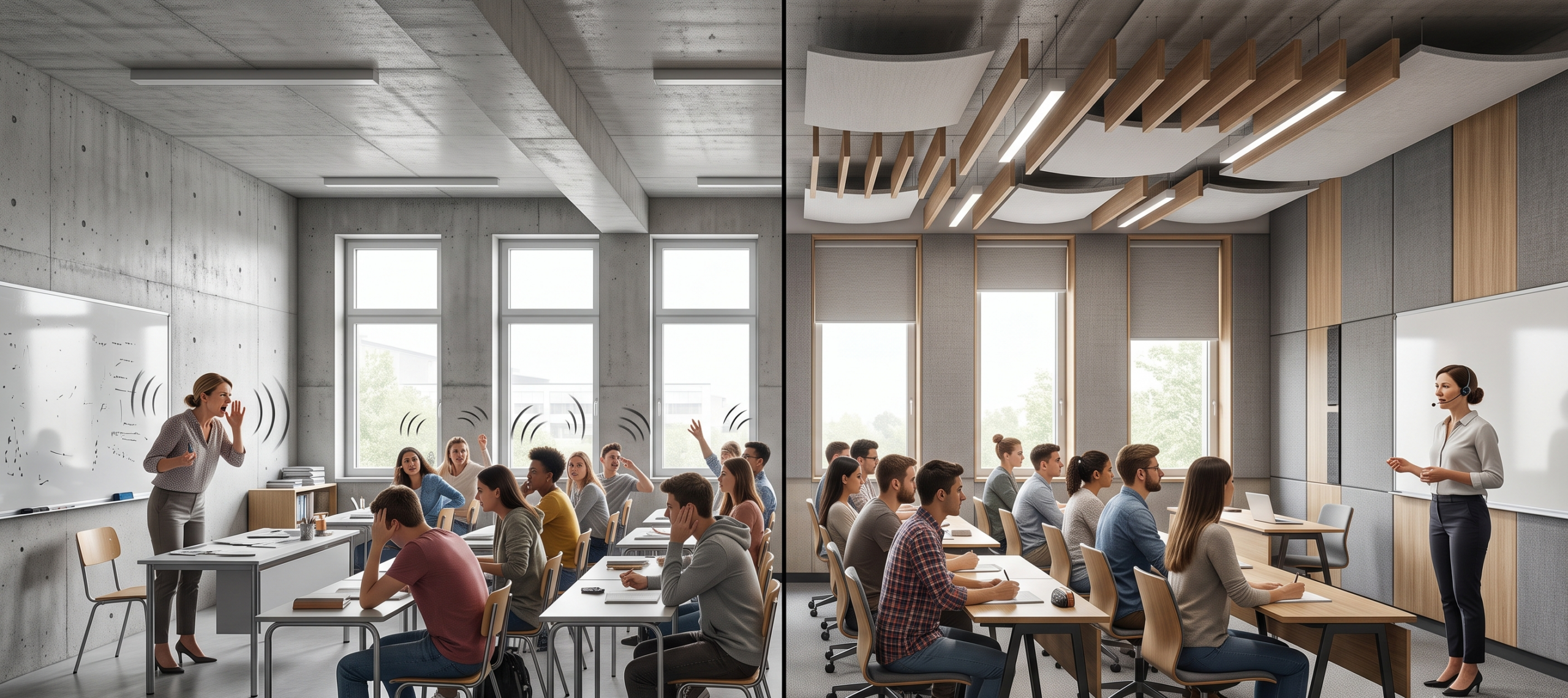

A classroom is more than just a space with desks, chairs, and teaching equipment. It is an environment where communication plays a central role in learning. Every lesson, discussion, presentation, and interaction depends on students being able to hear and understand information clearly.
However, many educational institutions unknowingly overlook one of the most important factors affecting learning outcomes: acoustics.
Students often struggle to hear teachers due to background noise, excessive reverberation, poor classroom layouts, and inadequate acoustic treatment. These issues can reduce concentration, increase fatigue, and negatively impact academic performance.
Research consistently shows that students learn more effectively when speech is clear and distractions are minimized. This is why modern educational facility design increasingly incorporates acoustic planning as a core component of classroom development.
In this article, we explore how thoughtful acoustic design can improve speech clarity, reduce noise, and create more effective learning environments.
Why Classroom Acoustics Matter
Teaching depends heavily on verbal communication.
If students cannot clearly understand what their teacher is saying, learning becomes more difficult regardless of curriculum quality or teaching methods.
Poor classroom acoustics can lead to:
- Reduced speech intelligibility
- Student distraction
- Increased teacher vocal strain
- Lower concentration levels
- Reduced academic performance
- Communication difficulties for younger students
The impact is often greater for students sitting farther from the teacher, students with hearing difficulties, and those learning in a second language.
Good classroom acoustics support equal learning opportunities for every student.
Understanding Speech Intelligibility
Speech intelligibility refers to how clearly spoken words can be understood by listeners.
In classrooms, speech intelligibility is one of the most important acoustic performance indicators.
Even if a teacher speaks loudly, excessive reverberation and background noise can make words difficult to understand.
Students should not have to constantly guess what is being said.
An acoustically optimized classroom allows spoken information to reach students clearly and naturally without requiring excessive vocal effort from teachers.
The Impact of Background Noise
Noise is one of the biggest obstacles to effective learning.
Common classroom noise sources include:
- Corridor activity
- Adjacent classrooms
- Outdoor traffic
- HVAC systems
- Ceiling fans
- Playground activity
- Student movement
- Building services
Even moderate background noise can interfere with concentration and reduce comprehension.
Young students are particularly vulnerable because they are still developing language processing skills.
Reducing noise distractions should be a primary objective in educational acoustic design.
Why Reverberation Affects Learning
When sound reflects repeatedly from walls, ceilings, floors, and other surfaces, reverberation occurs.
A small amount of reverberation can make speech sound natural, but excessive reverberation causes words to overlap.
As a result, students may hear sounds clearly but struggle to understand the actual content being spoken.
This becomes increasingly problematic in larger classrooms, lecture rooms, and training spaces.
Controlling reverberation is essential for maintaining high speech intelligibility.
Choosing the Right Classroom Materials
The materials used inside a classroom significantly influence acoustic performance.
Hard surfaces such as concrete, glass, tile flooring, and painted walls reflect sound and increase reverberation.
In contrast, sound-absorbing materials help control reflections and improve clarity.
Common acoustic solutions include:
- Acoustic ceiling tiles
- Fabric-wrapped wall panels
- Acoustic wall treatments
- Sound-absorbing ceiling systems
- Carpeted flooring in selected areas
- Acoustic baffles
The goal is to create a balanced acoustic environment that supports clear communication.
The Role of Acoustic Ceilings
Ceilings often represent the largest uninterrupted surface in a classroom.
As a result, they play a major role in controlling sound reflections.
Acoustic ceiling systems can significantly reduce reverberation and improve speech clarity.
Modern educational facilities frequently incorporate high-performance acoustic ceiling tiles because they provide effective sound absorption without affecting classroom aesthetics.
For many classrooms, ceiling treatment delivers some of the highest acoustic performance improvements relative to cost.
Classroom Layout and Acoustic Performance
Room layout influences how sound travels from the teacher to students.
Long, narrow classrooms may create uneven sound distribution, while excessive room depth can make it difficult for students at the rear to hear clearly.
Good classroom planning considers:
- Teacher position
- Student seating arrangements
- Room proportions
- Ceiling height
- Surface materials
Acoustic consultants often evaluate these factors during the design stage to ensure optimal communication throughout the room.
Reducing Noise Between Classrooms
In many schools, sound transmission between adjacent classrooms creates ongoing distractions.
Students may hear conversations, presentations, or activities from neighboring spaces.
This issue is particularly common in educational facilities where partition walls provide limited sound isolation.
Effective sound isolation may involve:
- Acoustic wall systems
- Insulated partitions
- Acoustic doors
- Improved sealing details
- Enhanced construction methods
Reducing inter-room noise helps maintain focus and improves learning conditions.
Supporting Teachers Through Better Acoustics
Classroom acoustics affect teachers as much as students.
In noisy environments, teachers often raise their voices repeatedly throughout the day to maintain attention and communication.
Over time, this can contribute to vocal fatigue and discomfort.
Well-designed classrooms allow teachers to speak naturally while remaining clearly audible throughout the room.
This benefits both teaching effectiveness and staff well-being.
Technology Cannot Replace Good Acoustics
Some schools attempt to solve acoustic problems through amplification systems or classroom audio technology.
While these systems can provide valuable support, they should not replace proper acoustic design.
A microphone cannot eliminate excessive reverberation or reduce background noise.
Technology performs best when integrated into a well-designed acoustic environment.
The most successful classrooms combine good architectural acoustics with appropriate educational technology.
Acoustic Design for Modern Learning Spaces
Today’s educational environments are evolving beyond traditional classrooms.
Schools increasingly incorporate:
- Collaborative learning spaces
- STEM laboratories
- Lecture rooms
- Training facilities
- Multi-purpose learning areas
These environments often support multiple activities simultaneously, making acoustic planning even more important.
Flexible learning spaces require flexible acoustic solutions capable of supporting different teaching styles and occupancy patterns.
The Benefits of Early Acoustic Planning
When acoustic considerations are included during the design phase, educational institutions can achieve:
- Improved speech clarity
- Better student concentration
- Reduced classroom distractions
- Enhanced learning outcomes
- Lower teacher vocal strain
- Improved occupant comfort
- Reduced need for costly retrofits
Early planning is generally more effective and economical than attempting to solve acoustic issues after construction.
Conclusion
Effective learning begins with effective communication.
When students can clearly hear and understand their teachers, classroom engagement, comprehension, and academic performance improve significantly.
Unfortunately, poor acoustics continue to affect many educational environments despite advances in teaching technology and facility design.
By controlling noise, reducing reverberation, selecting appropriate materials, and integrating acoustic planning into educational projects, schools can create learning environments that support both students and teachers.
Designing classrooms for better speech clarity and reduced noise is not simply an architectural consideration—it is an investment in educational success.
Frequently Asked Questions
What is speech intelligibility in a classroom?
Speech intelligibility refers to how clearly students can understand spoken words from teachers and presenters.
Why are classroom acoustics important?
Good acoustics improve learning, concentration, communication, and overall educational outcomes.
What causes poor speech clarity in classrooms?
Common causes include excessive reverberation, background noise, reflective surfaces, and poor room design.
How can noise be reduced in classrooms?
Noise can be controlled through acoustic ceilings, wall treatments, sound isolation systems, and proper building design.
Do acoustic panels help classrooms?
Yes. Acoustic panels reduce sound reflections and improve speech intelligibility.
Can classroom acoustics affect student performance?
Yes. Studies show that poor acoustic environments can negatively impact concentration, comprehension, and learning outcomes.
Should acoustics be considered during school design?
Absolutely. Early acoustic planning helps create more effective learning environments and reduces future correction costs.
What is the best acoustic solution for classrooms?
The best solution depends on room size, occupancy, noise sources, and educational objectives. Professional acoustic assessment is recommended.
Contact Auditorium Consultancy
Phone: +91 90150 60000
Email: [email protected]
Planning a new school, university, training facility, lecture hall, or educational campus?
Our acoustic consulting team helps educational institutions create learning environments with superior speech clarity, effective noise control, and enhanced acoustic performance through professional design and planning services.