
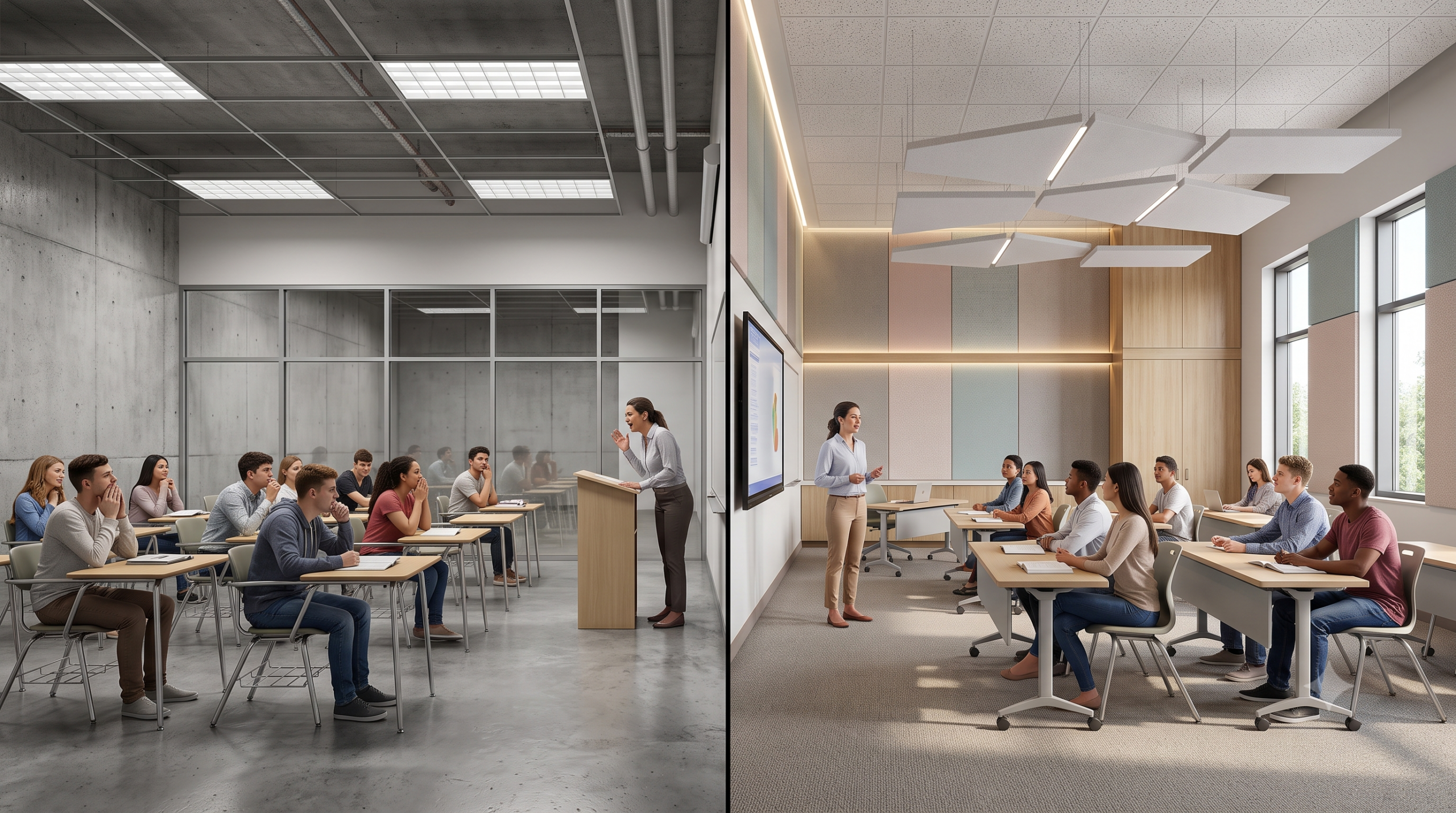

Educational institutions have evolved significantly over the past decade. Modern schools, colleges, universities, and training centers are no longer limited to traditional classrooms and lecture halls. Today’s campuses include collaborative learning spaces, auditoriums, seminar halls, libraries, innovation labs, conference facilities, recording studios, and multi-purpose learning environments.
While technology, architecture, and teaching methodologies continue to advance, one factor remains essential to effective learning: sound.
Students must be able to hear clearly, concentrate effectively, and communicate without unnecessary distractions. Unfortunately, acoustics are often overlooked during campus planning, resulting in spaces that look impressive but fail to support learning outcomes.
Poor acoustics can reduce speech intelligibility, increase student fatigue, create distractions, and negatively impact academic performance. This is why acoustic design has become a critical component of modern educational infrastructure.
In this article, we explore practical acoustic design strategies that help create productive, comfortable, and effective learning environments.
Why Acoustics Matter in Education
Learning depends heavily on communication.
Whether a teacher is explaining a concept, a student is participating in a discussion, or a guest speaker is delivering a presentation, information must be transmitted clearly and efficiently.
When acoustics are poor, students spend more effort trying to hear and understand than actually learning.
Common consequences of poor educational acoustics include:
- Reduced concentration
- Lower speech intelligibility
- Increased distractions
- Student fatigue
- Reduced learning efficiency
- Higher teacher vocal strain
A well-designed acoustic environment helps eliminate these barriers and supports better educational outcomes.
Design Learning Spaces Around Communication
One of the biggest mistakes in educational facility planning is focusing solely on aesthetics and capacity while overlooking communication requirements.
Every educational space serves a different purpose.
A classroom requires excellent speech clarity.
A library requires low background noise.
A seminar room requires balanced acoustics for discussions.
An auditorium requires both speech intelligibility and audience coverage.
Before designing any space, it is important to understand how communication will occur within that environment.
Acoustic goals should always align with the intended use of the space.
Control Reverberation for Better Speech Clarity
Reverberation occurs when sound reflects repeatedly from surfaces after the original sound is produced.
Excessive reverberation causes words to overlap, making it difficult for students to understand speech.
This issue is especially problematic in:
- Large classrooms
- Lecture halls
- Seminar rooms
- Training centers
- Auditoriums
Controlling reverberation through appropriate acoustic treatments improves speech clarity and creates a more comfortable learning environment.
The objective is not to eliminate all reflections but to achieve a balance that supports communication.
Invest in High-Performance Acoustic Ceilings
Ceilings often have the greatest impact on classroom acoustics.
Large ceiling surfaces reflect significant amounts of sound energy throughout a room.
Acoustic ceiling systems help absorb sound and reduce reverberation.
Modern educational facilities frequently use:
- Acoustic ceiling tiles
- Suspended acoustic clouds
- Ceiling baffles
- Acoustic plaster systems
These solutions improve speech intelligibility without affecting classroom functionality or aesthetics.
For many projects, ceiling treatment provides one of the most effective acoustic improvements available.
Reduce Noise from Adjacent Spaces
Noise transfer between rooms is a common issue in educational buildings.
Students may hear activities from nearby classrooms, corridors, laboratories, or common areas.
These distractions can significantly reduce concentration and teaching effectiveness.
Sound isolation should be considered when designing:
- Classroom partitions
- Seminar rooms
- Faculty offices
- Laboratories
- Examination rooms
Proper wall construction, insulation, doors, and sealing details help minimize unwanted sound transmission.
Address HVAC and Mechanical Noise
Many educational facilities invest in acoustic treatments but overlook mechanical noise sources.
Air-conditioning systems, ventilation equipment, pumps, generators, and ductwork can introduce continuous background noise that affects communication.
Students and teachers often become aware of this noise during lectures, examinations, and quiet study sessions.
Acoustic consultants typically coordinate with MEP engineers to ensure that building services support acoustic objectives.
Controlling mechanical noise is just as important as controlling reverberation.
Choose Materials Based on Acoustic Performance
Material selection plays a major role in acoustic quality.
Hard reflective materials such as glass, concrete, tile, and polished surfaces increase reverberation and noise levels.
Educational facilities should incorporate materials that provide appropriate sound absorption while maintaining durability and ease of maintenance.
Examples include:
- Fabric acoustic panels
- Acoustic ceiling systems
- Perforated wood panels
- Acoustic wall treatments
- Sound-absorbing finishes
Performance data should always be reviewed before finalizing specifications.
Create Better Learning Environments Through Acoustic Zoning
Not every area of a campus has the same acoustic requirements.
A library should remain quiet.
A cafeteria may tolerate higher activity levels.
A lecture hall requires speech clarity.
A student collaboration zone may encourage conversation.
Acoustic zoning helps separate activities with different noise characteristics and prevents conflicts between spaces.
Strategic planning of room locations can significantly improve overall campus acoustic performance.
Design Auditoriums and Lecture Halls Carefully
Large educational venues often present the greatest acoustic challenges.
Lecture halls and auditoriums must support:
- Clear speech
- Audience coverage
- Low background noise
- Controlled reverberation
Without proper planning, students seated at the rear may struggle to hear presentations clearly.
Acoustic consultants evaluate room geometry, seating layouts, ceiling design, and treatment placement to ensure consistent performance throughout the venue.
These spaces often benefit the most from professional acoustic design.
Support Hybrid and Technology-Enabled Learning
Modern educational institutions increasingly rely on digital learning technologies.
Video conferencing, online lectures, recording systems, and hybrid classrooms require better acoustics than traditional learning spaces.
Microphones and recording systems capture unwanted noise and reverberation just as easily as they capture speech.
Poor acoustics can reduce the quality of both in-person and remote learning experiences.
Acoustic design helps ensure that educational technology performs effectively and delivers clear communication.
Consider Student Well-Being
Acoustics influence more than academic performance.
Noisy environments increase stress, reduce comfort, and contribute to fatigue.
Students who spend several hours each day in acoustically poor environments may experience reduced concentration and increased cognitive effort.
Good acoustic design supports:
- Comfort
- Focus
- Communication
- Well-being
- Learning efficiency
Educational institutions that prioritize acoustics often create more positive and productive learning environments.
The Importance of Early Acoustic Planning
Acoustic issues are much easier to prevent than correct.
When acoustic considerations are included during planning and design, project teams can optimize room geometry, materials, building systems, and space layouts before construction begins.
Early acoustic planning often results in:
- Better performance
- Lower project risk
- Reduced retrofit costs
- Improved user satisfaction
- Enhanced learning outcomes
Waiting until occupancy to address acoustic problems usually leads to higher costs and more limited solutions.
Conclusion
Modern educational institutions are designed to inspire learning, collaboration, and innovation. However, these goals cannot be fully achieved without effective acoustic performance.
Students must be able to hear clearly, concentrate effectively, and communicate comfortably in every learning environment.
By controlling reverberation, reducing noise, selecting appropriate materials, and integrating acoustic planning from the beginning, schools and universities can create spaces that support both academic success and occupant well-being.
Acoustic design is not simply a technical requirement—it is an investment in the educational experience itself.
Frequently Asked Questions
What is educational acoustic design?
Educational acoustic design focuses on creating learning environments with clear communication, controlled noise levels, and improved speech intelligibility.
Why are acoustics important in schools and universities?
Good acoustics improve concentration, learning outcomes, communication, and overall student comfort.
How does reverberation affect classrooms?
Excessive reverberation causes speech to become unclear, making it harder for students to understand teachers.
What materials improve classroom acoustics?
Acoustic ceiling tiles, wall panels, perforated wood systems, and sound-absorbing finishes are commonly used.
Can poor acoustics affect student performance?
Yes. Poor acoustic environments can reduce concentration, comprehension, and learning effectiveness.
Why is HVAC noise important in educational buildings?
Mechanical noise can interfere with communication and distract students during learning activities.
What is acoustic zoning?
Acoustic zoning involves separating noisy and quiet activities within a campus to reduce sound conflicts.
When should acoustic consultants be involved in educational projects?
Ideally during the planning and design stages to ensure optimal performance and avoid costly modifications later.
Contact Auditorium Consultancy
Phone: +91 90150 60000
Email: [email protected]
Planning a school, college, university, training center, lecture hall, or educational campus?
Our acoustic consulting team helps educational institutions create high-performance learning environments through professional acoustic planning, noise control strategies, reverberation management, and educational facility design support.