
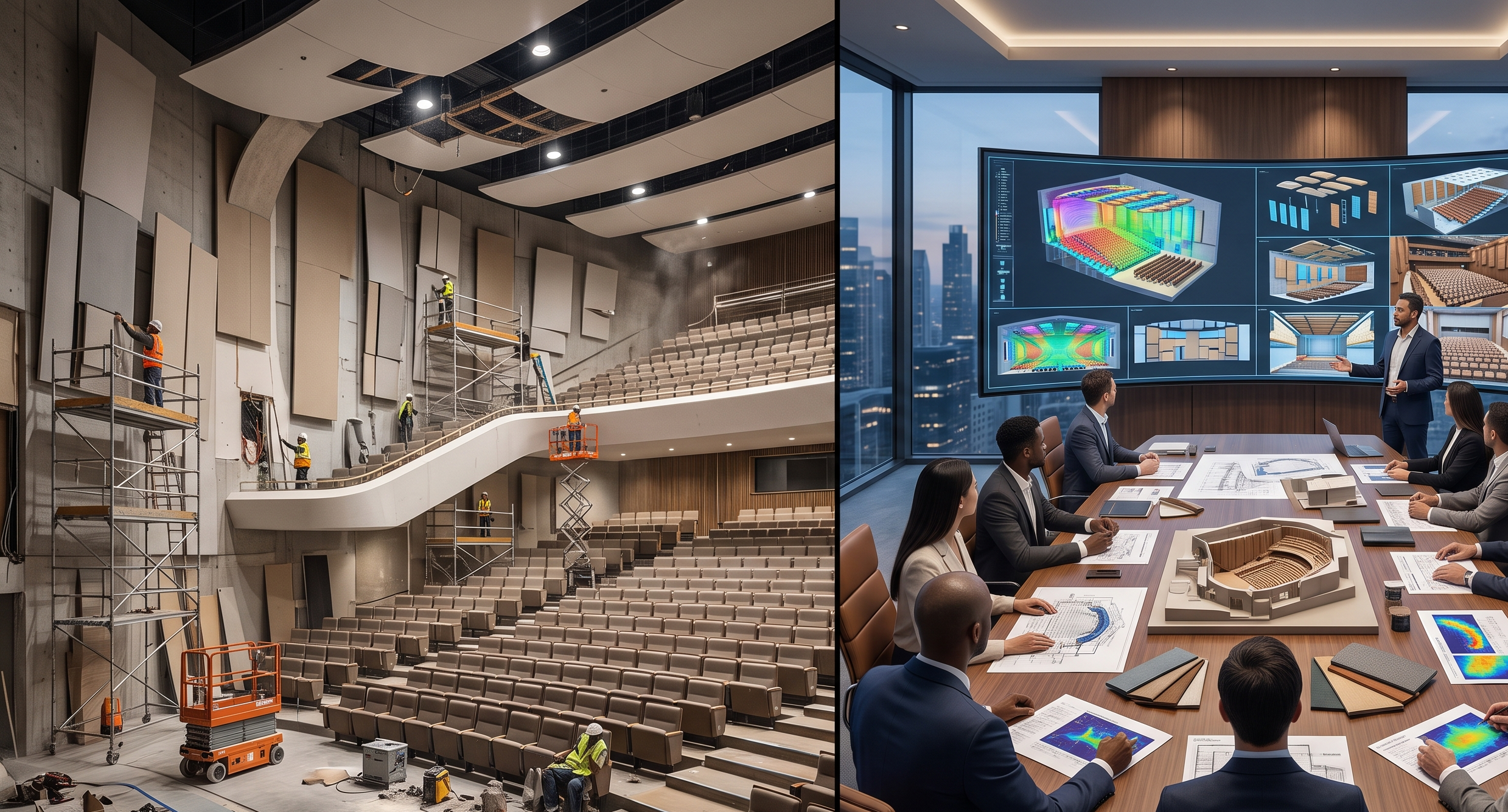

Construction projects involve countless decisions that affect the performance, functionality, and long-term value of a building. Architects, engineers, consultants, contractors, and project owners work together to ensure that every element contributes to the success of the final facility.
However, one area that is frequently overlooked during the early stages of planning is acoustics.
Many project teams focus on structural systems, architectural design, interiors, MEP services, and technology infrastructure while assuming that acoustic issues can be addressed later. Unfortunately, this approach often leads to costly modifications, project delays, reduced performance, and dissatisfied occupants.
Whether the project involves an auditorium, educational institution, convention center, office building, healthcare facility, or commercial development, acoustics should be considered from the very beginning.
Early-stage acoustic planning is not an additional expense. It is a strategic investment that helps avoid problems before they occur and ultimately saves both time and money throughout the project lifecycle.
Why Acoustics Are Often Ignored During Planning
Unlike architectural finishes or structural elements, acoustics are not immediately visible.
A building can appear perfectly designed on paper while still containing serious acoustic problems.
Because sound behavior cannot be easily visualized through traditional drawings or renderings, many stakeholders underestimate its importance until construction is completed and occupants begin using the space.
Unfortunately, acoustic issues discovered after occupancy are often the most expensive to correct.
This is why experienced project teams increasingly involve acoustic consultants during the earliest design stages.
The Cost of Fixing Acoustic Problems Later
When acoustic planning is delayed, project teams frequently encounter issues such as:
- Excessive reverberation
- Poor speech intelligibility
- Sound leakage between rooms
- HVAC noise problems
- Uneven sound distribution
- Occupant complaints
- Reduced functionality
Correcting these problems after construction may require:
- Removing finished surfaces
- Rebuilding partitions
- Installing additional acoustic treatments
- Modifying ceiling systems
- Upgrading doors and glazing
- Reconfiguring MEP services
These modifications often cost significantly more than addressing the same issues during the design phase.
In many cases, project schedules are also affected, creating additional financial implications.
Acoustic Planning Starts with Building Design
Good acoustics begin long before acoustic panels are installed.
The shape, size, and layout of a building influence how sound behaves within a space.
Factors such as:
- Room proportions
- Ceiling heights
- Wall geometry
- Seating layouts
- Surface materials
- Functional zoning
all contribute to acoustic performance.
When these decisions are made without acoustic input, opportunities for optimization may be lost.
Early acoustic planning allows project teams to integrate performance requirements directly into the architectural design.
Reducing Design Revisions
Design revisions are a major source of project delays and budget overruns.
When acoustic requirements are identified late, drawings often require updates and coordination between multiple disciplines.
This may involve changes to:
- Architectural layouts
- Ceiling systems
- Mechanical services
- Electrical infrastructure
- Interior finishes
Each modification creates additional design effort and increases project complexity.
By addressing acoustic requirements during concept development, project teams can reduce revisions and improve coordination throughout the design process.
Improving Coordination Between Disciplines
Acoustics affect multiple building systems.
Effective acoustic design requires collaboration between:
- Architects
- Structural engineers
- MEP consultants
- Interior designers
- Technology consultants
- Project managers
When acoustic consultants participate early, potential conflicts can be identified before they become construction issues.
This collaborative approach improves decision-making and reduces the likelihood of costly redesigns later.
Optimizing Material Selection
Material selection plays a major role in acoustic performance.
Without acoustic planning, projects may specify materials that create excessive sound reflections or fail to achieve sound isolation requirements.
Changing materials after procurement or installation can significantly impact project budgets.
Early acoustic consultation helps identify suitable materials before specifications are finalized.
This ensures that acoustic performance, aesthetics, durability, and budget considerations are balanced from the outset.
Preventing Sound Isolation Problems
Many buildings require effective sound separation between spaces.
Examples include:
- Classrooms
- Conference rooms
- Auditoriums
- Healthcare facilities
- Recording studios
- Corporate offices
If sound isolation requirements are not addressed during design, occupants may experience noise disturbances that affect productivity and comfort.
Retrofitting sound isolation solutions after construction often involves major modifications to walls, ceilings, doors, and glazing systems.
Early planning helps avoid these expensive corrections.
Controlling Mechanical Noise Before Installation
HVAC systems are among the most common sources of building noise.
Air handling units, ductwork, fans, pumps, and generators can introduce unwanted background noise that affects occupant comfort.
Once mechanical systems have been installed, correcting noise issues can be technically challenging and expensive.
Acoustic consultants work with MEP engineers during the design phase to ensure that building services meet acoustic performance targets before installation begins.
This proactive approach saves time and prevents future complaints.
Supporting Better Auditorium and Performance Venue Design
Auditoriums, theaters, lecture halls, and convention centers require particularly careful acoustic planning.
These spaces depend on:
- Speech intelligibility
- Audience coverage
- Controlled reverberation
- Noise control
- Sound distribution
Acoustic challenges in these environments can significantly affect the success of the venue.
By integrating acoustic considerations into the earliest stages of design, project teams can create spaces that deliver superior performance without requiring extensive modifications later.
Enhancing Occupant Satisfaction
The ultimate goal of any building is to serve its occupants effectively.
Poor acoustics can lead to:
- Communication difficulties
- Reduced concentration
- Increased stress
- Lower productivity
- User complaints
When acoustic performance is incorporated into the planning process, buildings become more comfortable, functional, and enjoyable to use.
Satisfied occupants contribute to the long-term success of a facility.
The Financial Benefits of Early Acoustic Planning
Many project owners assume acoustic consulting increases project costs.
In reality, early planning often reduces overall expenditure by preventing costly mistakes.
Benefits include:
- Fewer design revisions
- Reduced construction changes
- Lower retrofit costs
- Improved material selection
- Better coordination
- Faster project delivery
- Reduced maintenance issues
The cost of prevention is almost always lower than the cost of correction.
Acoustic Planning Is a Long-Term Investment
Buildings are designed to operate for decades.
Acoustic decisions made during the design phase continue to influence performance throughout the life of the facility.
Investing in acoustic planning early helps ensure that spaces remain functional, comfortable, and effective for years to come.
This long-term perspective delivers value far beyond the initial construction period.
Conclusion
Successful construction projects are built on proactive planning, informed decision-making, and effective collaboration.
Acoustics should never be viewed as an optional consideration or a problem to solve after construction. Instead, it should be integrated into the project from the very beginning.
Early-stage acoustic planning helps reduce costs, prevent delays, improve building performance, and enhance occupant satisfaction.
Whether designing an educational institution, auditorium, convention center, commercial building, or public facility, investing in acoustic planning during the design phase is one of the smartest decisions a project team can make.
The most cost-effective acoustic solution is the one that is planned before construction begins.
Frequently Asked Questions
Why is early acoustic planning important?
Early acoustic planning helps prevent costly design changes, construction modifications, and performance issues later in the project.
Does acoustic consulting increase project costs?
While acoustic consulting involves an initial investment, it often reduces overall project costs by preventing expensive corrections and rework.
When should an acoustic consultant be involved?
Ideally during concept design and planning stages before major architectural decisions are finalized.
Can acoustic issues be fixed after construction?
Yes, but corrections are often more expensive, disruptive, and less effective than addressing issues during design.
What types of projects benefit from acoustic planning?
Auditoriums, schools, universities, healthcare facilities, offices, convention centers, theaters, and commercial developments.
How does acoustic planning improve project coordination?
It helps architects, engineers, and consultants identify potential issues early and align their designs accordingly.
Can acoustic planning reduce construction delays?
Yes. Early identification of acoustic requirements reduces design revisions and construction-related modifications.
What is the biggest benefit of early acoustic planning?
The ability to prevent problems before they occur, saving both time and money throughout the project lifecycle.
Contact Auditorium Consultancy
Phone: +91 90150 60000
Email: [email protected]
Planning an auditorium, educational institution, convention center, commercial facility, or performance venue?
Our acoustic consulting team helps architects, developers, contractors, and project owners integrate acoustic performance into the design process from day one, ensuring better results, reduced costs, and long-term project success.