
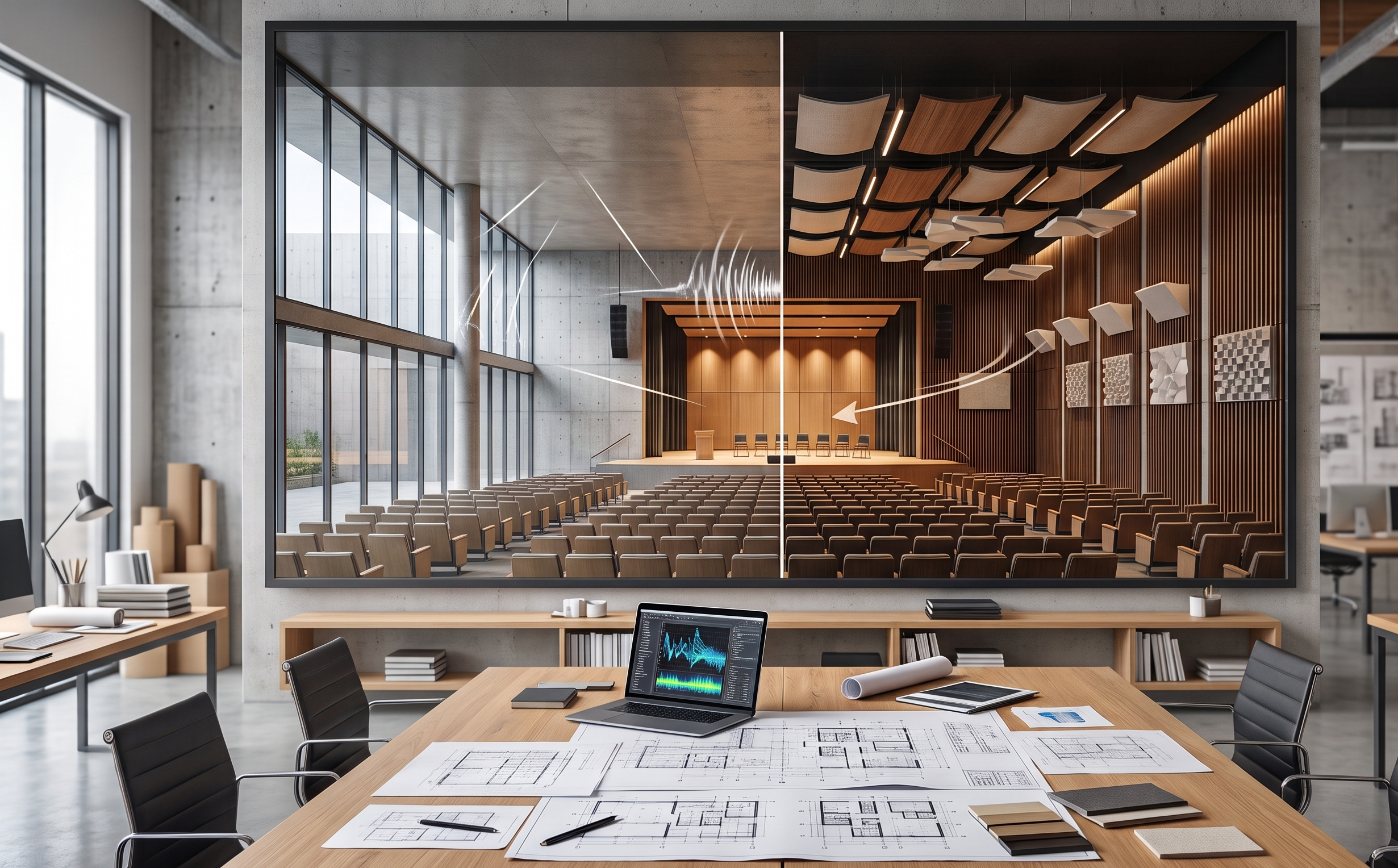

Modern architecture is expected to deliver much more than visual appeal. Today’s buildings must provide comfort, functionality, sustainability, and a high-quality user experience. One aspect that significantly influences user experience—but is often underestimated during design—is acoustics.
A beautifully designed auditorium, conference hall, classroom, theater, or commercial space can quickly become frustrating if occupants struggle to hear presentations, conversations, or performances clearly. In many projects, acoustic problems are not caused by poor construction or inadequate technology. They are often the result of design decisions made during the planning stage.
The challenge is that acoustic issues usually become noticeable only after a building is occupied. By then, corrections can be expensive, disruptive, and sometimes impossible without significant modifications.
Through years of acoustic consulting across auditoriums, educational institutions, convention centers, theaters, and commercial developments, certain mistakes appear repeatedly. Understanding these common errors can help architects create spaces that not only look impressive but also perform exceptionally well.
1. Considering Acoustics Too Late in the Design Process
One of the most common mistakes is treating acoustics as something that can be addressed after the architecture is finalized.
Many projects focus heavily on layouts, aesthetics, structural systems, and interiors before considering how sound will behave within the space.
By the time acoustic consultants become involved, room geometry, ceiling heights, wall configurations, and material selections have already been decided.
Acoustic performance begins with architectural planning. The earlier acoustics are considered, the easier it becomes to achieve optimal results without increasing project costs.
2. Assuming Acoustic Panels Can Solve Every Problem
Acoustic panels are valuable tools, but they are not a cure for poor design.
Many projects attempt to fix acoustic issues simply by installing wall panels after construction. While acoustic treatments can improve performance, they cannot fully compensate for unsuitable room geometry, poor sound isolation, excessive mechanical noise, or incorrect material selections.
Effective acoustics require a complete strategy rather than a single product solution.
3. Ignoring Room Shape and Geometry
Sound follows the architecture of a space.
Long parallel walls, excessive ceiling heights, curved reflective surfaces, and poorly positioned balconies can significantly affect acoustic performance.
These design elements influence how sound reflects, disperses, and reaches the audience.
A room with poor geometry may suffer from:
- Flutter echo
- Sound focusing
- Dead zones
- Uneven coverage
- Excessive reverberation
Good acoustics start with good room design.
4. Overusing Reflective Materials
Contemporary architecture often incorporates glass, marble, polished stone, metal finishes, and exposed concrete.
While these materials create visually striking interiors, they also reflect large amounts of sound energy.
When reflective materials dominate a space, speech clarity decreases and reverberation increases.
The solution is not eliminating these finishes but balancing them with absorptive and diffusive acoustic treatments.
Successful acoustic design works with architecture rather than against it.
5. Designing Without Clear Acoustic Objectives
Different spaces require different acoustic characteristics.
A lecture hall requires excellent speech intelligibility.
A concert venue may require longer reverberation times.
A conference center demands clarity and low background noise.
Yet many projects use generic acoustic solutions without defining performance objectives.
Before selecting materials or treatments, project teams should clearly identify how the space will be used and what acoustic outcomes are expected.
6. Neglecting Ceiling Acoustics
Architects frequently focus on walls while overlooking ceilings.
However, ceilings often represent the largest uninterrupted surface within a room and have a major impact on sound behavior.
Without proper treatment, ceilings can contribute to excessive reflections and reduced speech clarity.
Acoustic clouds, ceiling baffles, reflectors, and absorptive ceiling systems can dramatically improve acoustic performance when integrated into the design.
7. Underestimating Mechanical Noise
A room may have excellent acoustics yet still perform poorly if background noise levels are excessive.
Air-conditioning systems, ventilation equipment, pumps, generators, and ductwork often introduce unwanted noise.
This problem is particularly noticeable in:
- Auditoriums
- Conference halls
- Educational facilities
- Boardrooms
- Performance venues
Mechanical noise control should be considered alongside architectural acoustics from the beginning of the project.
8. Confusing Acoustic Treatment with Soundproofing
This is one of the most widespread misconceptions in the construction industry.
Acoustic treatment improves sound quality inside a room.
Soundproofing reduces sound transmission between rooms.
Installing acoustic wall panels inside a conference room will not necessarily stop conversations from being heard outside.
Both objectives require different design strategies, materials, and construction methods.
Understanding this distinction is essential for achieving project goals.
9. Selecting Materials Based Only on Appearance
Many products marketed as “acoustic” offer limited performance benefits.
Architects often choose materials based on aesthetics without reviewing technical acoustic data.
Before specifying acoustic products, designers should evaluate:
- NRC ratings
- Absorption coefficients
- Fire ratings
- Durability
- Maintenance requirements
A visually attractive material may not provide the acoustic performance required for the project.
Performance data should always support design decisions.
10. Not Engaging Acoustic Consultants Early
Perhaps the most expensive mistake is waiting too long to involve acoustic specialists.
Acoustic consultants evaluate:
- Room geometry
- Reverberation characteristics
- Sound isolation requirements
- Mechanical noise
- Material performance
- Audience coverage
- Speech intelligibility
Their recommendations often influence architectural decisions that become difficult or costly to modify later.
Projects that involve acoustic consultants during concept development generally achieve better results with fewer revisions.
Why These Mistakes Continue to Occur
Acoustics are often invisible during design reviews.
Architects can easily visualize lighting, finishes, furniture, and layouts through renderings and models.
Sound behavior, however, is more difficult to predict without specialized analysis.
As a result, acoustic issues may remain unnoticed until the building becomes operational.
This highlights the importance of acoustic simulations, performance modeling, and professional consultation during the design process.
The Value of Early Acoustic Consulting
When acoustics are integrated into the project from the beginning, teams gain several advantages:
- Better speech intelligibility
- Improved user comfort
- Reduced design revisions
- Lower retrofit costs
- Better venue performance
- Enhanced occupant satisfaction
- Improved long-term value
Acoustic consulting is not simply about solving problems—it is about preventing them before they occur.
Conclusion
Architectural success is measured not only by how a building looks but also by how effectively it functions.
Acoustic performance plays a critical role in shaping user experience across auditoriums, educational institutions, theaters, conference centers, and commercial facilities.
By avoiding these common acoustic treatment mistakes and involving acoustic consultants early in the design process, architects can create spaces that deliver exceptional performance, comfort, and long-term value.
The best acoustic solutions are rarely achieved through corrections after construction. They are achieved through informed planning from the very beginning.
Frequently Asked Questions (FAQ)
Why should architects consider acoustics during design?
Because room geometry, materials, and layouts directly affect sound quality and are difficult to change later.
What is the difference between acoustic treatment and soundproofing?
Acoustic treatment improves sound quality inside a room, while soundproofing reduces sound transmission between spaces.
Can acoustic panels solve all acoustic problems?
No. Acoustic panels are only one part of a complete acoustic strategy.
Why does room shape matter in acoustics?
Room geometry influences sound reflections, reverberation, and audience coverage.
When should an acoustic consultant be involved?
Ideally during concept design and planning stages.
Are acoustics important for educational institutions?
Yes. Speech intelligibility directly affects learning outcomes and communication quality.
What is the biggest acoustic mistake in building design?
Treating acoustics as an afterthought rather than integrating it into the design process.
Do commercial buildings require acoustic planning?
Absolutely. Offices, conference facilities, meeting rooms, and collaborative workspaces all benefit from professional acoustic design.
Contact Auditorium Consultancy
Planning an auditorium, theater, educational institution, convention center, conference hall, or commercial facility?
Our acoustic consultants help architects, developers, institutions, and project teams create spaces with superior acoustic performance through professional analysis, design guidance, reverberation control, sound isolation planning, and acoustic treatment strategies.
Phone: +91 90150 60000
Email: [email protected]
Contact our team today to discuss your project and ensure acoustics are integrated into your design from day one.